Campaign design team
Why We Should End Duplicated Medical Coverage in Car Insurance: Building a Smarter, Nonprofit System for All
By Vincent Cordova · August 16, 2025
One of the most glaring inefficiencies in our current insurance system is that Americans are forced to pay for the same type of coverage multiple times through different channels. We often do not see it because the system is intentionally complex, but the waste becomes obvious once you step back.
Today, if you are injured in a car accident, your medical bills could be paid by health insurance, by auto insurance through personal injury protection, by workers’ compensation if the accident happened on the job, and in some cases by liability coverage. Each of those systems builds accident risk into its premiums, which means the same American family can be paying for the same medical care several times over.
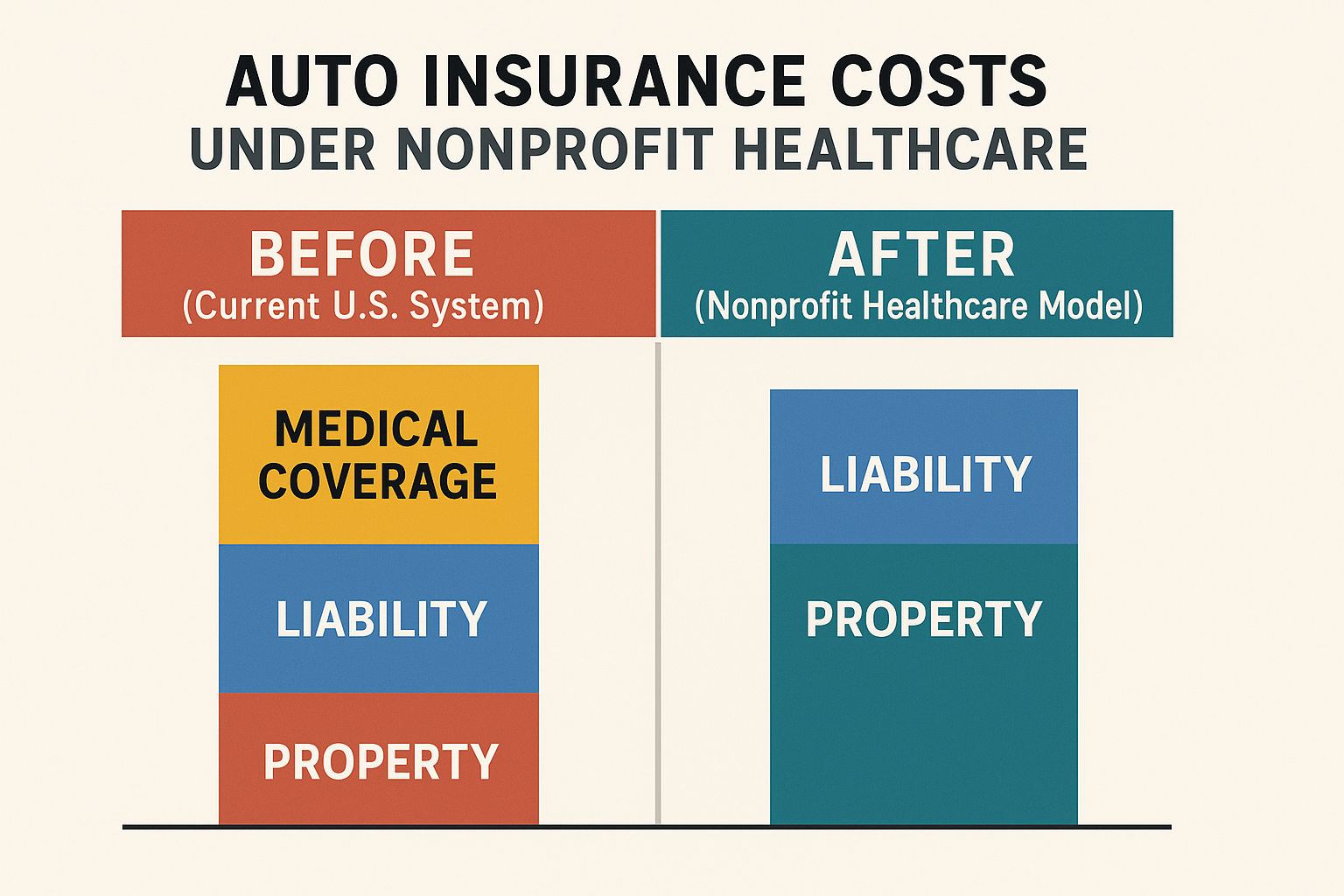
That duplication is not just inefficient. It is a sign that our system is built around overlapping incentives instead of a single public purpose. Medical care should not be split between multiple industries and then sold back to the public in pieces. Accident-related medical costs should be consolidated into healthcare, where they belong, and auto insurance should be narrowed to the role it should play: property damage, repairs, replacement, and non-medical liability.
The strongest precedent for that approach is New Zealand’s Accident Compensation Corporation. ACC is not a perfect model, and it is not a nonprofit healthcare model. It is an injury system layered on top of a health system. But it is still a strong precedent for consolidating accident medical coverage into one place. New Zealanders gave up the right to sue for personal injury in exchange for ACC coverage, except in narrow cases of exemplary damages. That is the trade, and it is not a footnote.
The campaign should decide the tort question openly, on the merits, rather than assuming New Zealand’s answer. Researchers found that thirty years after ACC implementation, New Zealand hospitals were no safer than comparable Western countries. ACC delivered faster and fairer compensation. It did not deliver the patient-safety gains its designers hoped for. That matters. It means the case for consolidation is strong, but the case for treating ACC as proof that nonprofit healthcare is inexpensive is weak.
ACC also covers injury only. It does not cover illness, disease, or gradual degeneration. That distinction matters because accident medical coverage is one thing and healthcare is another. We should not let the accident system be described as a general healthcare model when it is not.
ACC is under fiscal strain as well. Projections indicate a potential funding gap of roughly $26.3 billion by 2030 on current trends. That does not make the consolidation idea invalid. It makes the policy design more important. A public system can absorb accident medical costs without pretending that every injury scheme is costless or frictionless.
The real benefit of consolidation is not that it makes the system simple in the abstract. It is that it removes a layer of duplication from the lives of ordinary families. A person injured in a crash should not have to fight through multiple insurers to receive care. A family should not be forced to pay for the same medical protection through different channels. The cost should be carried in the healthcare system that already exists, not in a patchwork of overlapping premiums.
The same logic applies to the broader healthcare system. If medical care is universal and public, then accident-related medical costs belong there. Auto insurance should be stripped back to property and liability. Workers’ compensation should be narrowed. The public should be able to understand what is being bought and what is being paid for without having to decode six layers of policy language.
That is the purpose of this reform. It is not about pretending the problem disappears. It is about making the system honest. It is about deciding openly whether society wants to preserve a duplicative insurance structure or whether it wants a plain and accountable one. The campaign should make that choice in public, and it should make it on the merits.
Community Comments
Community Comments
Share a public response to this post. Submissions are reviewed before they appear.
0 approved comments
Loading comments...