Campaign design team
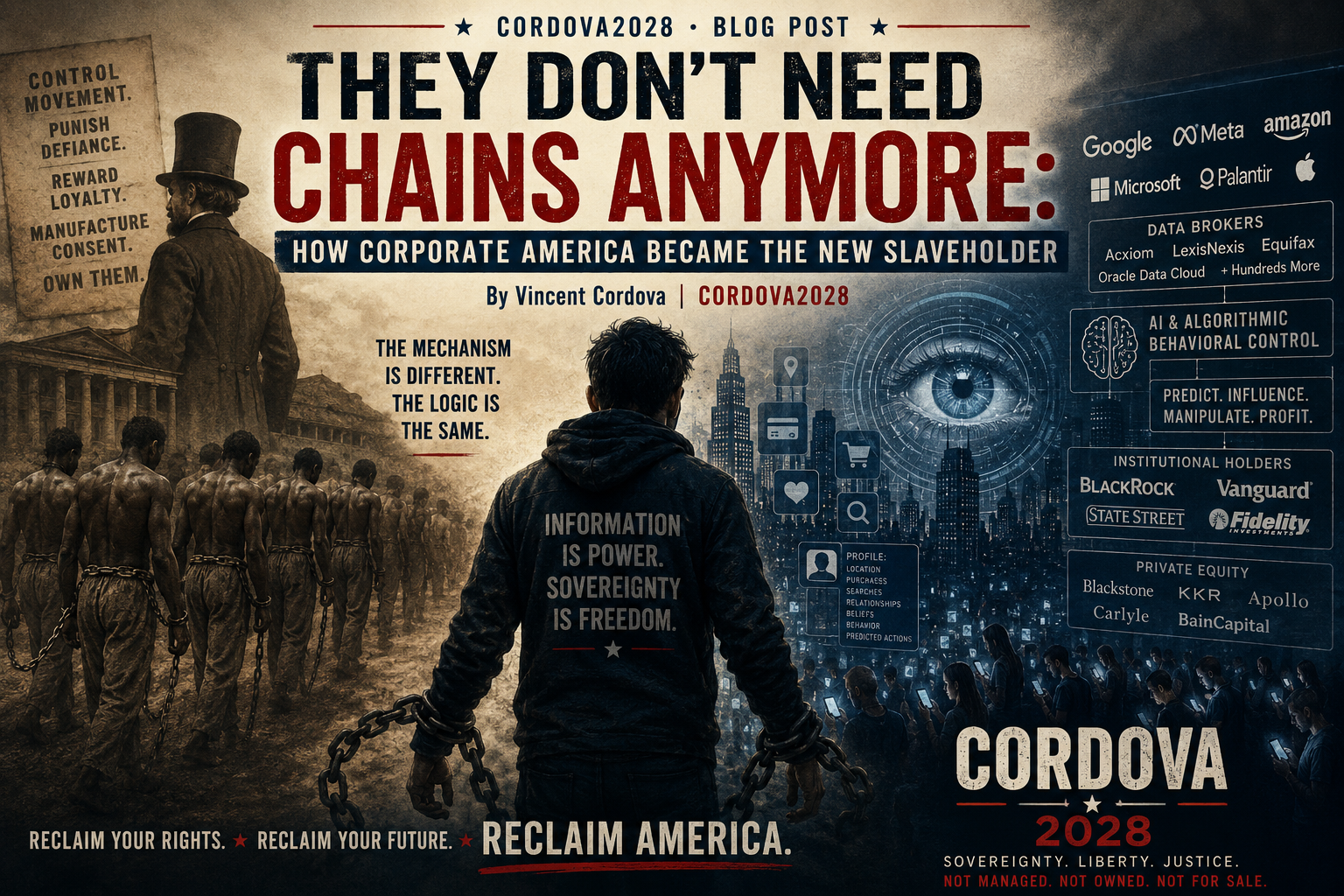
They Don’t Need Chains Anymore: How Corporate America Became the New Slaveholder
By Vincent Cordova | Cordova 2028
May 23, 2026
Let me say something that most politicians will never say out loud.
The system you live inside — the one that tracks where you go, what you buy, what you search for at 2 in the morning, who you talk to, what makes you angry, what makes you afraid — was not built for your convenience.
It was built to manage you.
And the people who built it learned how to do it from the oldest playbook in American history.
The Throughline Nobody Wants to Name
Slaveholders did not simply own people. That is the surface reading of history. What slaveholders actually did was build a system of total behavioral control — one that monitored movement, surveilled communication, punished non-compliance, rewarded loyalty, isolated individuals from one another, and manufactured consent through a combination of fear, dependency, and the deliberate destruction of any alternative.
They did not need every enslaved person to be in chains at every moment. They needed the architecture to be inescapable. The system itself was the instrument of control.
Now look at what has been built in the last thirty years.
A small number of corporations — backed by an even smaller number of institutional holders and private equity firms — have constructed a surveillance infrastructure that reaches into every home, every pocket, every conversation, every search, every purchase, every relationship. They know more about you than your doctor. More than your priest. More, in many cases, than you know about yourself.
And they are using that knowledge — right now, today — to shape what you believe, what you want, how you vote, what you fear, and whether you comply.
They do not need chains anymore. They have something more efficient.
Who Built This and How
This did not happen by accident. It happened through deliberate design, financed by capital, and protected by a Congress that has been purchased by the same entities it was supposed to regulate.
The Data Brokers
There is an entire industry — largely invisible to the public — whose sole function is to collect, package, and sell information about you without your meaningful consent. Companies like Acxiom, LexisNexis, Equifax, Oracle Data Cloud, and hundreds of smaller operations hold files on virtually every American adult. These files contain your location history, your purchase history, your health inferences, your political leanings, your psychological profile, your financial stress indicators, your relationship status, and your predicted future behavior.
They sell this data to advertisers. To political campaigns. To insurance companies. To landlords. To employers. And — through a legal loophole that should be a national scandal — to government agencies that are prohibited by the Constitution from collecting it themselves.
Read that again. The government cannot legally surveil you without a warrant. So it pays corporations to do it instead, then buys the results. The Fourth Amendment has been quietly outsourced.
The AI Layer
Raw data is powerful. Data processed by artificial intelligence is something else entirely.
The AI systems now operating inside every major social media platform, every major retail operation, every major financial institution, and increasingly every major government contractor are not neutral tools. They are behavioral engines. They are designed — explicitly, intentionally — to predict your behavior and then alter it.
The algorithm does not show you what is true. It shows you what keeps you on the platform. What makes you angry enough to stay. What makes you afraid enough to click. And once it knows what moves you, it can be used to move you in any direction the operator chooses.
This is not a hypothetical future threat. This is the current operating model.
The Institutional Holders
Behind the data brokers and the AI platforms and the social media companies sit the institutional holders: BlackRock, Vanguard, State Street, Fidelity. They are the largest shareholders in virtually every company named in this document simultaneously. They hold major stakes in Google, Meta, Amazon, Microsoft, Palantir, and the data broker industry all at once.
This is not passive investment. Institutional holders exercise governance power through proxy votes, board appointments, and what they call “stewardship” — which is a polite word for telling corporations what to do. When the same small group of asset managers controls the surveillance infrastructure, the AI layer, the social media platforms, and the data broker industry simultaneously, the phrase “competitive market” becomes a fiction.
What you have instead is a unified control system operated by entities that answer to no electorate, no constitution, and no public interest standard of any kind.
The Private Equity Angle
Private equity firms have moved aggressively into sectors that directly touch civilian life: healthcare, housing, media, local news, and increasingly technology infrastructure. Their operating model is identical in every sector — extract maximum financial return in minimum time, regardless of consequences to workers, communities, or the public interest.
In the surveillance economy, PE firms finance and flip data companies, AI startups, and behavioral analytics firms. They are not building these companies because they believe in them. They are building them because behavioral data on the American civilian population is, at this moment in history, one of the most valuable commodities on earth. And they intend to monetize every bit of it.
The Fragmentation Tactic
Here is something the private equity industry does not advertise but uses constantly.
Every regulation has a threshold. A dollar amount. A user count. A contract value. A size trigger. And wherever a threshold exists, private equity firms build around it — deliberately spreading surveillance operations across networks of smaller entities, each one carefully kept below whatever line would trigger the prohibition, while the aggregate surveillance capability of the entire network remains exactly what the regulation was designed to stop.
It is called regulatory fragmentation. It is one of the oldest and most reliable tools in the PE playbook. And it is why most data privacy regulations, however well-intentioned, fail to reach the capital that actually controls the surveillance economy.
The Cordova framework eliminates every threshold. No size floor. No contract minimum. No trigger to engineer around. The prohibition applies to every entity regardless of how small — and the aggregate activity of any network of affiliated entities under common ownership or control is treated as the activity of a single entity. The PE firm that built the network is as liable as the entity running the surveillance. The institutional holder that financed it is as liable as both.
The fragmentation tactic stops working the moment it is explicitly named and closed. We are naming it. We are closing it.
The Public-Private Merger No One Voted For
Here is the mechanism that ties this together and makes it genuinely dangerous.
The federal government — under administrations of both parties — has systematically outsourced intelligence and surveillance functions to private contractors. The National Security Agency. The Department of Homeland Security. Local law enforcement fusion centers. They all rely heavily on private contractors for technology, data, and analytical capabilities.
What this means in practice is that the legal wall between government surveillance (which requires warrants, oversight, and constitutional compliance) and private surveillance (which requires almost nothing) has been effectively demolished.
The government can hand a private contractor a list of people it wants information on. The contractor already has the data because you clicked “I Agree” on a terms of service document that you did not read in 2014. The contractor provides the information. No warrant. No court order. No constitutional problem — officially.
This is not a conspiracy theory. This is documented, litigated, and ongoing.
When you add artificial intelligence to this arrangement — AI systems capable of processing millions of behavioral data points to predict and preemptively flag “dissent,” “radicalization,” “non-compliance,” or any other category the operator defines — you have built something that the architects of the Constitution never imagined and would have prohibited instantly if they had.
You have built a managed population system.
The Foreign Dimension Nobody Is Talking About
There is one more layer to this that almost never gets named in polite political conversation, and it needs to be named.
The data collected on you — your location, your health, your beliefs, your psychological profile, your vulnerabilities — is not staying in the United States.
Foreign governments purchase American civilian data from data brokers. Legally. Today. With almost no restriction. Adversarial foreign intelligence services do not need to hack American systems to understand the American population. They can simply buy the data on the open market, because the open market has no meaningful prohibition on who can purchase it.
American data companies export raw surveillance data to foreign affiliates and subsidiaries for processing — offshore, outside US jurisdiction, beyond the reach of any domestic regulation — and then import the finished behavioral profiles back into the United States. The data export route has become one of the primary mechanisms for stripping constitutional protection from American civilian surveillance data entirely.
And if a future government — or a current one — wants to acquire American civilian surveillance data in a way that is difficult to trace, the simplest mechanism is a foreign intelligence-sharing arrangement. Route the request through a foreign partner. Receive back data that would have required a warrant to collect domestically. Officially, no constitutional violation occurred. The data just arrived from abroad.
This is not hypothetical. It is how surveillance architectures are designed when the architects understand that constitutional constraints apply at the border.
The Cordova framework closes this. Incorporating outside the United States does not exempt any entity from these prohibitions. Exporting data offshore for processing and returning results domestically does not circumvent the prohibition. No foreign government, no foreign state-owned enterprise, and no foreign intelligence service may purchase, receive, or act upon American civilian data for purposes of surveillance, profiling, or behavioral manipulation. And no federal agency may acquire offshore what it is prohibited from collecting at home.
American data belongs to Americans. Full stop.
What a Managed Population Looks Like
Let me be plain about what this means in practical terms, because the language of surveillance and data collection can feel abstract until you understand what it produces.
A managed population is one in which:
- Dissent becomes visible before it becomes organized. The system knows who is talking to whom, what they are saying, and how their sentiment is trending. Movements can be identified, infiltrated, discredited, or suppressed before they reach critical mass. This is not a capability being developed. It exists today.
- Economic compliance is enforced through access. Your credit score, your insurance rates, your employment background check, your ability to rent housing, your access to financial services — all of these are increasingly determined by data profiles assembled without your knowledge or consent. Non-compliance with the expectations of the system carries real economic consequences.
- The information environment is controlled. You do not choose what information reaches you. The algorithm chooses. And the algorithm serves the interests of the entity that built it and the capital behind it. A population that cannot access accurate information cannot make meaningful democratic choices.
- Fear and division are manufactured inputs. The behavioral data shows exactly what divides people, what frightens them, and what keeps them passive. The system feeds those inputs deliberately. A divided, frightened, distracted population is a manageable population. A united, informed, organized population is a threat to the arrangement.
- Resistance is pre-labeled as extremism. Anyone who names the system, who organizes against it, who demands accountability, risks being categorized by an AI-driven threat assessment tool as a potential destabilizing actor. The definitions of “threat” are set by the entities running the system. There is no external check.
If you read that list and thought: this sounds like what slaveholders did — you are right. The mechanism is different. The underlying logic is identical. Control the information. Control the economics. Control the fear. And the population manages itself.
Your Data Is Being Sold. Right Now. Today.
Here is something that 40% of Americans did not know until recently: the government has been buying your data from private brokers.
Not with a warrant. Not with probable cause. With a credit card.
But the government is not the only buyer. Your location data — including visits to doctors’ offices, places of worship, reproductive health clinics, political events, and legal proceedings — is sold to advertisers, political campaigns, anti-abortion groups, employers, landlords, and anyone else willing to pay. In 2024, a U.S. senator revealed that a data broker had sold location data tied to visits to nearly 600 Planned Parenthood clinics across 48 states. An anti-abortion group used it to target those individuals with millions of personalized ads.
That is not a hypothetical. That happened. It is legal. It is happening right now.
Your psychological vulnerabilities — your grief, your fear, your loneliness, your financial stress, your addiction patterns — have been identified by AI systems trained on your behavioral data, packaged into a psychological profile, and sold to whoever will pay the most for it. Insurance companies. Political campaigns. Predatory lenders. Platforms that want to know exactly which emotional trigger will keep you engaged longest.
A person’s psychological vulnerabilities are not a product. They are not an asset. They are private, they are human, and in a country that believes in the dignity of the individual, they belong to the individual alone.
The data broker industry — approximately 4,000 companies operating with almost no federal regulation — holds files on virtually every American adult. These files are bought and sold and resold in a chain of transactions you never consented to, never knew about, and have almost no ability to stop. By the time your data has been resold three times, the entity that holds it has no legal relationship to you at all.
79% of Americans are concerned about how their data is used. 84% say the federal government should pass stricter data privacy laws. 73% say they don’t have enough control. 80% say government agencies should need a warrant before buying their location data.
They are not confused. They are not divided. They are waiting.
This Is What America Is Supposed to Be
The Constitution was not written to protect the government from the people. It was written to protect the people from consolidated power — whatever form that power takes.
The founders feared standing armies. They feared centralized economic control. They feared the concentration of information and communication in the hands of a single authority. They built structural protections against every form of that threat they could anticipate.
They did not anticipate a private entity with no democratic accountability accumulating more surveillance capability than any government in human history. They did not anticipate a system in which the rights that protect you from government overreach can be bypassed entirely by routing the same function through a corporation.
But the principle is clear. The principle has always been clear.
Americans do not consent to being managed. By anyone. With any technology. For any purpose.
The government does not have the right to control the civilian population. That is settled. What is not yet settled — and what the Cordova administration will settle — is that corporations do not have that right either.
There is no version of freedom in which a private entity can do to you what the government is prohibited from doing.
There is no version of democracy in which the information environment that shapes your beliefs and your votes is controlled by entities that profit from your compliance.
There is no version of America in which the slaveholder’s playbook — updated for the digital age, financed by Wall Street, and protected by a captured Congress — is an acceptable operating model for civil society.
What the Cordova Administration Will Do
This is not a problem that responds to a press release or a blue-ribbon commission. It requires direct, immediate, legally binding action — and structural accountability that no single administration can dismantle.
On day one, I will sign an Executive Order closing the public-private surveillance loophole, prohibiting federal agencies from purchasing your data without a warrant, and banning — immediately and without exception — the sale of American civilian psychological vulnerability data. Your grief, your fear, your loneliness, your mental health — those stop being products on day one.
I will send to Congress the American Civilian Sovereignty Act — permanent federal law with civil and criminal penalties, a private right of action for every American citizen, and two new national institutions that the American people have been asking for:
The National Do Not Sell Registry — a free, permanent, simple mechanism through which any American can prohibit the sale of their personal data by any covered entity. You register once. It applies everywhere. No entity may sell your data after you register.
The National Data Transaction Registry — so that any American can look up every transaction that has involved their data, who bought it, what they paid, and what they said they would use it for. The supply chain that profits in the dark will operate in public.
I will call on Congress to establish the Constitutional People’s Counsel — an independent officer of Congress who cannot be fired by any President, cannot be defunded by any administration, and has standing to take any entity — corporate or governmental — to court on your behalf.
And I will initiate the process of a Constitutional Amendment establishing permanently that American civilian data is not a commodity — that the sale of your psychological vulnerabilities, your location history, your health data, or your private life without your specific consent is a constitutional violation — and that the rights protecting you from government apply equally to every corporation operating at population scale.
84% of Americans want this. Republicans. Democrats. Independents. Every region. Every age group. The only thing standing between the American people and these protections has been a Congress more responsive to the capital that funds it than to the people who elected it.
That changes.
A Final Word
I want to be direct with you about something.
The system described in this document profits from your distraction. It profits from your division. It profits from your sense that nothing can change and that no one in power actually sees what is happening.
Every time you dismiss this as too big to fight, the system wins.
Every time you accept the terms of service without reading them, the system wins.
Every time you watch the argument about culture war politics and forget to ask who is funding both sides of it, the system wins.
I am not running for president to manage you. I am running because I believe the American people, fully informed and fully organized, are ungovernable by any system that does not have their consent.
That is the America I intend to build.
Community Comments
Community Comments
Share a public response to this post. Submissions are reviewed before they appear.
0 approved comments
Loading comments...